
How Much Rainwater Can You Collect From Your Roof?
Turn rainfall into a measurable water resource with smart rainwater harvesting
Every time it rains, thousands of litres of water may fall on the roof of a home, hotel, school, commercial building, or institution. In most properties, this valuable resource simply flows through gutters and drains and leaves the site.
But what if you could calculate exactly how much water your roof could collect?
A Rainwater Harvesting Calculator helps you estimate your property's rainwater collection potential using factors such as roof catchment area, annual rainfall, collection efficiency, and water demand.
Understanding these numbers is the first step toward designing a rainwater harvesting system that can reduce water bills, decrease tanker dependency, support groundwater conservation, and potentially move a property toward Net Water Positive operation.
Your Roof Is More Than a Roof — It's a Water Catchment
A roof acts as a large rainwater collection surface.
When rain falls onto the roof, it can be directed through gutters and downpipes into a properly designed rainwater harvesting system. After debris removal, first-flush diversion, filtration, storage, and appropriate treatment, the collected water can be reused for different applications.
The amount of water available can be surprisingly large.
For example, approximately 1 mm of rainfall falling on 1 square metre of roof represents 1 litre of water before collection losses.
That means a property with a large roof can potentially capture hundreds of thousands—or even millions—of litres over a rainy season, depending on local rainfall.
How Is Rainwater Collection Calculated?
A simple estimation can be made using:
Rainwater Collection = Roof Area × Annual Rainfall × Collection Efficiency
Collection efficiency is important because not every litre of rainfall reaching a roof ultimately enters the storage system.
Some water may be lost because of evaporation, splash, first-flush diversion, gutter overflow, roof characteristics, or filtration.
For example, a well-designed and maintained rainwater harvesting system may achieve a relatively high collection efficiency, while poorly maintained systems may collect considerably less.
Why Roof Area Matters
The larger your catchment area, the greater your potential water collection.
Rainwater harvesting can therefore be particularly valuable for properties such as hotels and resorts, schools and universities, hospitals and institutions, apartment complexes, factories, warehouses, farmhouses, commercial buildings, and large residential properties.
A hotel with several thousand square feet of roof area should not look at rainfall simply as weather. That roof represents a potential water source.
Rainfall Is Only Half of the Calculation
Knowing how much rainwater you can collect is useful, but it does not answer the most important question:
How much of your property's water requirement can rainwater actually meet?
This is why an effective water assessment should compare annual rainwater harvesting potential with actual water consumption.
For example, if a property requires 2,000 litres of water per day, its annual requirement would be approximately:
2,000 × 365 = 730,000 litres/year
If the roof can practically harvest 800,000 litres per year, the annual collection potential is greater than the stated annual demand.
However, that does not automatically mean the property can operate entirely on rainwater throughout the year. Rainfall is seasonal, so storage capacity, rainfall distribution, treatment, backup supply, and daily demand must also be considered.
That distinction is important when designing a genuinely reliable system.
What Does “Net Water Positive” Mean?
For a rainwater harvesting assessment, a useful indicator is whether the calculated annual rainwater potential exceeds the property's annual water requirement.
A property with sufficient catchment and rainfall may have the potential to move toward a Net Water Positive water strategy.
But achieving this in practice requires more than a favourable calculation.
The property also needs an appropriate combination of collection infrastructure, first-flush management, filtration, storage, treatment, reuse, recharge, monitoring, and responsible water consumption.
The calculator should therefore be viewed as a planning and feasibility tool, not the final engineering design.
Why Rainwater Harvesting Is Especially Important in the Hills
In Himalayan regions such as Himachal Pradesh, an interesting contradiction exists: properties may experience substantial seasonal rainfall while still facing water shortages during other periods.
Hotels and buildings can become dependent on tanker water even though significant quantities of rain fall directly onto their roofs.
The problem is often not simply a lack of rainfall.
It is a lack of infrastructure to capture, clean, store, recycle, recharge, and intelligently manage that rainfall.
A properly planned system converts seasonal rainfall from uncontrolled runoff into a usable asset.
From Roof to Reusable Water
A complete rainwater harvesting system goes considerably beyond installing a storage tank.
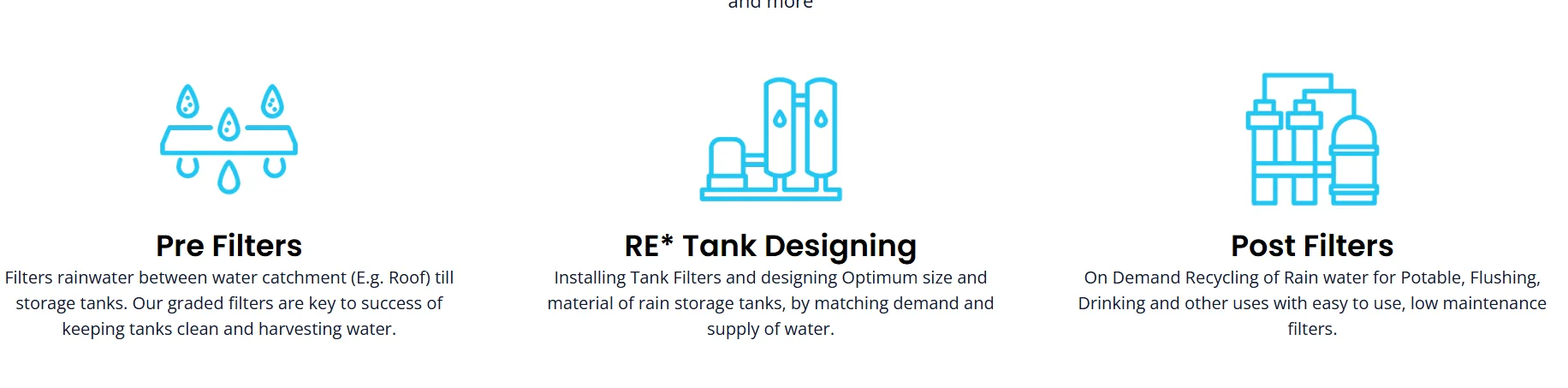
At The Ridge Environment Consultants, the objective is to manage rainwater through an integrated process that can include roof catchment, debris screening, first-flush diversion, filtration, storage, post-filtration, disinfection or purification where required, reuse, groundwater recharge, and system monitoring.
The exact treatment process should always depend on the intended use of the collected water.
Water intended for landscaping or flushing does not necessarily require the same treatment as water intended for higher-quality applications.
How the Rainwater Harvesting Calculator Helps
The calculator shown on the Ridge Water Harvesting website brings the important planning variables together.
Users can enter their roof catchment area, select or enter local annual rainfall, choose an estimated collection efficiency, provide the number of users, and enter the property's daily water requirement.
The result can then help estimate the property's annual rainwater harvesting potential and compare available rainfall against water demand.
Instead of asking:
“Should I install rainwater harvesting?”
the better question becomes:
“How much water is already falling on my property, and how much of it can I realistically use?”
Rainwater Should Be Treated as a Resource
Rainwater harvesting isn't simply about putting a tank underground.
It is about understanding the water balance of a property.
How much rain falls on the site? How much can the roof capture? How much water does the property consume? How much storage is required? What treatment is needed? How much tanker or municipal water could potentially be replaced? And where should excess rainfall go once storage is full?
When these questions are answered together, rainwater harvesting becomes part of a broader water-management strategy rather than an isolated piece of equipment.
Calculate Before You Build
Whether you're planning a new hotel, home, institution, commercial building, or upgrading an existing property, calculate the rainwater potential before deciding the size of the harvesting system.
Your roof may already be receiving a substantial amount of water every year.
The opportunity is to capture it before it becomes runoff.